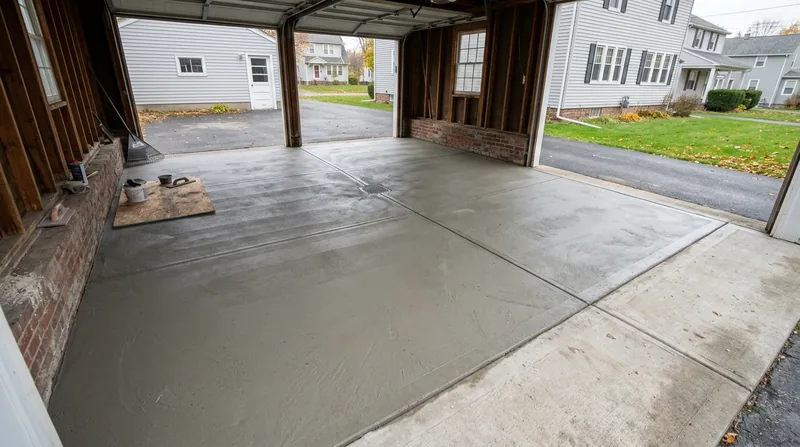




Garage floors in Buffalo take a beating from freeze-thaw cycles, road salt tracked in on tires, and the heavy seasonal swings of Western New York winters. A well-built concrete garage floor stops oil stains, moisture seepage, and cracking before they start, protecting your foundation and giving you a clean, level surface that lasts decades. Buffalo's glacial clay-silt terrain and relentless spring thaw mean drainage and proper base prep are non-negotiable. Whether you're pouring a new floor for a detached garage in Allentown, replacing a failed slab in a South Buffalo double, or adding a finished floor to a newer Clarence colonial, we build garage floors that stand up to lake-effect snow, salt spray, and the wet ground conditions that plague the region.
Why Garage Floor Durability Matters in Buffalo's Harsh Freeze-Thaw Climate
Buffalo winters are not forgiving. Dozens of freeze-thaw cycles each season, combined with road salt and the moisture that lingers in our glacial soil, destroy unsealed or poorly prepared concrete. A garage floor that isn't properly finished, sealed, and built on a solid gravel base will scale, spall, and crack within five to ten years. You'll end up with a slippery, stained surface that accelerates rust on tools and vehicles, and moisture wicking up through the slab into the garage framing and insulation.
- We pour slabs on a well-compacted gravel base with tight control joints to manage the frost heave and settling common in Western New York.
- A smooth trowel or broom finish gives you slip resistance and easy cleanup for oil, salt, and road grime.
- Sealing after cure locks out moisture and stains, extending the life of your floor by ten years or more.
- We follow local setback and drainage codes so water doesn't pool under the slab or flood your foundation.
The result is a garage floor that handles salt-crusted snow melt, parked vehicles, and seasonal swings without cracking, heaving, or staining.
Key info: In Buffalo, the biggest threat to concrete is water. Our glacial lake-plain soil drains slowly, and freeze-thaw cycles force moisture into any crack or hairline fissure. A sealed garage floor is not a luxury; it's insurance against the climate. For permit and code requirements in Erie County, check the Erie County Department of Public Works and your municipality's building department.
How We Build Your Garage Floor: From Site Prep to Seal
A lasting garage floor starts before concrete ever hits the ground. We assess drainage, compact the subgrade, lay a gravel base, and set up forms and control joints so the slab moves and settles with the soil instead of cracking. We finish the surface to your preference, let it cure fully, and seal it to resist stains and moisture. The whole process typically takes two to three weeks from excavation to drive-on.
- We excavate and grade the garage floor area to ensure proper slope for drainage away from your foundation.
- A compacted gravel base, typically four to six inches, absorbs frost heave pressure and keeps the slab stable.
- We set control joints every four to six feet in a grid pattern so the concrete shrinks along planned lines, not in random cracks.
- The concrete is placed, screeded level, and finished with a broom or smooth trowel based on your slip-resistance needs.
- After seven days of cure, we apply a penetrating sealer to protect against oil, salt, and moisture.
This step-by-step approach is what keeps Buffalo garage floors sound through decades of seasonal stress.
Local example: A homeowner in Kenmore had a 20-year-old garage floor that was heaving and cracking from frost. We excavated, installed proper drainage and a new four-inch gravel base, poured a six-inch slab with control joints every five feet, and sealed it. Eighteen months later, the floor is flat, clean, and holding up to snow-melt salt without any new cracks. That's the difference between a floor built for Buffalo and one that just happened to be poured.
Garage Floor Methods and Finish Options
Not every garage floor needs the same finish or thickness. A detached single-car garage in a residential neighborhood has different demands than a multi-car bay that will see heavy tool storage or equipment. We tailor the concrete mix, thickness, and surface finish to your use case and budget. Our most common approaches are listed below.
| Approach | Description | Best for |
|---|---|---|
| Standard 4-inch slab | Concrete poured four inches thick on a compacted gravel base, finished with a broom texture for slip resistance, sealed after cure. | Single-car garages, tool storage, vehicles parked indoors without heavy machinery or chemical exposure. |
| 6-inch reinforced slab | Thicker pour with wire mesh or rebar, rated for heavier loads, better frost resistance, and reduced cracking in high-stress areas. | Multi-car bays, equipment storage, areas with poor drainage or a history of frost heave. |
| Smooth trowel finish | Concrete finished flat and smooth with a steel trowel, easier to sweep and hose clean, requires more frequent sealing. | Garages where appearance matters, easier cleanup of oils and salt, homeowners who don't mind resealing every two to three years. |
| Sealed and stained | Concrete finished and sealed with a protective coating, optional acrylic stain for color, matte or satin sheen. | Attached garages visible from the street, new construction, homeowners seeking a polished, finished appearance. |
Each approach meets Buffalo's climate demands; the choice depends on your use and budget. We'll walk you through the options during your free estimate.
Garage Floors Cost in Buffalo: What to Expect
Garage floor pricing in Buffalo starts at around $5 per square foot for a standard four-inch slab with a broom finish and basic sealing. A typical single-car garage (roughly 250 square feet) runs $1,200 to $1,500; a two-car bay (400 to 500 square feet) typically falls between $2,000 and $2,500. The final cost depends on several factors specific to your site and the Buffalo climate.
Your actual price moves up or down based on: the condition and drainage of your existing soil (poor drainage or high water table in West Seneca or Cheektowaga requires extra gravel and site prep), whether you're replacing an existing floor (removal and disposal add labor), the finish you choose (smooth trowel costs more than broom), and whether you want sealing included upfront. A six-inch reinforced slab with better frost resistance runs about 20 to 30 percent more than standard. If your garage sits on a slope or in a low spot prone to water pooling, we may recommend additional drainage work, which increases the cost but protects your foundation for decades.
We always recommend getting two to three estimates so you can compare approaches and pricing. Our estimates are free and include a site walk, soil assessment, and a detailed breakdown of materials and labor. Visit our pricing page for more detailed cost breakdowns and examples by garage size and finish type.
What to Look for When Hiring a Concrete Contractor Near Me in Buffalo
A garage floor is a long-term investment, and the contractor you hire matters as much as the concrete mix. When you're comparing contractors near Buffalo, focus on insurance, references, and a clear understanding of your project scope. Don't choose based on price alone; the lowest bid often means shortcuts on base prep, drainage, or sealing that will haunt you in five years.
- Verify that the contractor carries general liability and workers compensation insurance and can provide a current certificate of insurance on request.
- Ask for references from recent garage floor jobs in your neighborhood, Kenmore, West Seneca, or Cheektowaga, and call at least two to confirm quality and timeline.
- Confirm that the contractor understands local drainage and frost-heave requirements specific to glacial clay soil and Buffalo's seasonal freeze-thaw.
- Get a written estimate that breaks down base prep, concrete, finishing, sealing, and any site-specific work like grading or drainage correction.
- Ask about your municipality's permit requirements for garage floor work and whether the contractor will handle or coordinate permitting with your local building department.
A contractor who takes time to assess your site, explains the work clearly, and stands behind their sealing and finish is worth the investment. Contact us today for a free estimate and a straightforward conversation about your garage floor needs.
Garage Floors in Buffalo: Pricing Guide
| Service | Price | Details |
|---|---|---|
| Standard 4-inch slab | Starting at $5/sq ft | Broom finish, control joints, basic sealing included; single-car garage typically $1,200 to $1,500 |
| 6-inch reinforced slab | Starting at $6.50/sq ft | Wire mesh or rebar, better frost resistance and load capacity; poor drainage or frost-heave history increases demand |
| Smooth trowel or sealed finish | Add 15-25% | Labor-intensive polishing and finish work; sealed and stained options cost more upfront but reduce resealing frequency |
| Site prep and drainage | Varies | Excavation, grading, gravel base, and drainage correction for sloped or wet sites; glacial clay soil often requires extra base work |
| Removal and disposal | $1.50-$3/sq ft | Removing and hauling an existing failed slab adds cost; necessary for heaved or cracked floors in Buffalo's climate |
| Free estimate | No charge | Site walk, soil and drainage assessment, written quote within 24 hours, no obligation to book |
Indicative pricing, the exact cost depends on square footage, finish, and site access. Free personalized estimate within 24h at (716) 517-4106.


